
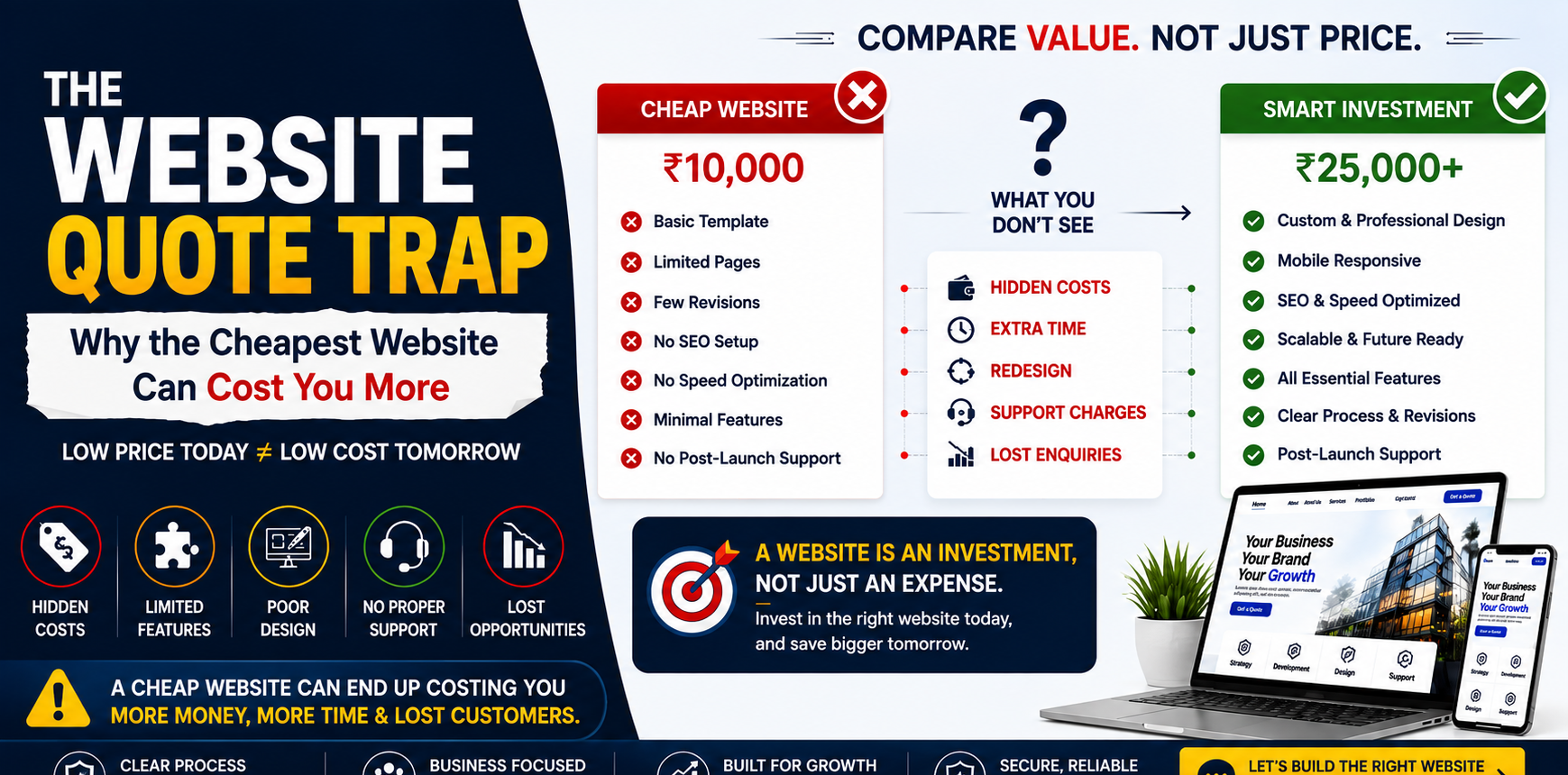
When you decide to build a website for your business, getting multiple quotations sounds like the right thing to do.
You contact three or four website companies.
One quotes ₹8,000.
Another says ₹15,000.
Another quotes ₹30,000.
Naturally, the first question that comes to mind is:
“Why should I pay ₹30,000 when someone else can build it for ₹8,000?”
It’s a fair question.
But there’s something many businesses overlook:
A website quotation is not just a price. It’s a scope of work.
Two companies can offer a “business website” at completely different prices while delivering completely different things.
And that’s where the website quote trap begins.
The Cheapest Quote Isn’t Always the Cheapest Website
Imagine you receive these two proposals.
Option A — ₹8,000
- 5 pages
- Ready-made template
- Basic contact form
- Limited customization
- Client provides content
- Limited revisions
- No post-launch support
Option B — ₹25,000
- Custom-designed pages
- Mobile-responsive layout
- Business-focused structure
- Professional content guidance
- Enquiry forms
- WhatsApp integration
- Basic SEO setup
- Analytics
- Multiple revisions
- Post-launch support
At first, ₹8,000 looks cheaper.
But you’re not actually comparing ₹8,000 with ₹25,000.
You’re comparing two different deliverables.
That’s why the first question shouldn’t be:
“Who is cheapest?”
It should be:
“What exactly am I getting?”
1. Look Beyond the Headline Price
A quotation may mention:
Business Website – ₹9,999
But what does that actually include?
Before accepting it, check:
- How many pages?
- Custom design or template?
- Who provides the content?
- Are images included?
- Is mobile optimization included?
- Is SEO setup included?
- Is WhatsApp integration included?
- Are forms included?
- Is domain included?
- Is hosting included?
- How many revisions?
- What support is provided?
A low price can sometimes simply mean a smaller scope.
2. Hidden Costs Can Change the Final Price
The initial quote isn’t always the final amount you’ll spend.
Additional requirements can include:
Extra page → Additional charge
Content writing → Additional charge
Premium plugin → Additional charge
WhatsApp integration → Additional charge
Payment gateway → Additional charge
Future changes → Additional charge
Maintenance → Additional charge
There’s nothing wrong with charging separately for additional work.
The problem is when the business owner doesn’t know about these costs before starting.
A good quotation should make the scope clear from day one.
3. A Cheap Website Can Become Expensive to Change
Your business won’t remain exactly the same forever.
Today you may need:
Home + About + Services + Contact
Tomorrow you may want:
- Portfolio
- Products
- Case Studies
- Testimonials
- Blog
- Landing pages
- Online booking
- Customer enquiry system
If the website wasn’t planned with future expansion in mind, adding new functionality may require significant redevelopment.
So when comparing agencies, ask:
“Can this website grow with my business?”
4. Don’t Pay Twice for the Same Website
One of the biggest costs isn’t the original website.
It’s having to rebuild it later.
A business might initially choose a very cheap solution.
Then six months or one year later:
“The website doesn’t represent us anymore.”
Now they need:
Redesign + migration + new content + development + SEO work
The original low-cost decision may have resulted in paying twice.
Sometimes investing properly at the beginning can reduce the need for an expensive rebuild later.
5. Design Isn’t Just About Making a Website Look Pretty
A professional website isn’t necessarily the one with the most animations.
Good website design should make it easy for visitors to understand:
- What your business does
- What you offer
- Who you serve
- Why they should trust you
- What they should do next
A beautiful website that confuses visitors isn’t necessarily a successful business website.
Design should support the business—not distract from it.
6. Content Can Make a Huge Difference
Consider these two service descriptions:
“We provide industrial solutions.”
versus
“We provide customized industrial automation solutions for manufacturers looking to improve production efficiency and reduce operational downtime.”
The second immediately gives the visitor more context.
Your website doesn’t just need pages.
It needs clear communication.
Before accepting a quotation, find out whether the agency is only designing pages or helping structure the website around your business.
7. Ownership Should Never Be an Afterthought
This is one of the most important questions businesses should ask:
“Will I have complete access to my website?”
You should clearly understand access to:
- Domain
- Hosting
- WordPress/CMS
- Website administrator
- Business email
- Website files
- Database
- Analytics
- Other important accounts
Your website is a business asset.
You shouldn’t discover after the project is completed that you don’t have access to something important.
8. What Happens After the Website Goes Live?
The website launch isn’t necessarily the end of the project.
What happens if:
- A form stops working?
- You need to update a number?
- A new service needs to be added?
- You encounter a technical issue?
- You need help managing the website?
This is where support becomes important.
When comparing two quotations, don’t just ask:
“How much does the website cost?”
Also ask:
“What happens after launch?”
9. The Cheapest Website Can Cost You in Lost Opportunities
There’s another cost that’s harder to calculate.
Lost customers.
Suppose a potential customer visits your website and sees:
- Outdated information
- Confusing navigation
- Poor presentation
- No clear enquiry option
- Unprofessional branding
They may simply leave.
You may never know that customer visited.
That’s why the cost of a website isn’t only the amount you pay the developer.
It can also include the business opportunities your website helps you gain—or lose.
10. Compare Value, Not Just Price
Before choosing a website company, create a simple comparison.
| Factor | Agency A | Agency B |
|---|---|---|
| Number of Pages | ||
| Custom Design | ||
| Mobile Responsive | ||
| Content Support | ||
| SEO Setup | ||
| Forms | ||
| WhatsApp Integration | ||
| Domain/Hosting | ||
| Revisions | ||
| Admin Access | ||
| Post-Launch Support | ||
| Future Scalability |
You may discover that the cheapest quotation isn’t actually offering the lowest total cost.
7 Questions to Ask Before Accepting Any Website Quote
Before signing a website project, ask:
1. What exactly is included in the quoted price?
2. What isn’t included?
3. Are there any recurring or additional costs?
4. Who owns the domain, hosting and website?
5. How many revisions are included?
6. What support will I receive after launch?
7. Can the website be expanded later?
If an agency answers these questions clearly, you’re in a much better position to compare quotations.
The Real Question Isn’t “How Cheap Can I Get a Website?”
The better question is:
“What website will give my business the right value for the money I invest?”
A professional website doesn’t have to be unnecessarily expensive.
And an expensive website isn’t automatically a good website either.
The important things are:
Clear scope.
Right technology.
Professional design.
Useful functionality.
Business-focused content.
Ownership.
Support.
Future scalability.
That’s what you should actually compare.
Final Thought
A ₹10,000 website isn’t necessarily a bad investment.
A ₹50,000 website isn’t necessarily a good investment.
The price alone doesn’t tell you the value.
Before choosing the lowest quotation, understand what you’re buying, what you’re not buying, and what your business may need six months or two years from now.
Because sometimes:
The cheapest website is only the cheapest on Day 1.
And the website that looked expensive initially may actually be the one that saves your business money in the long run.
🚀 Planning a New Business Website?
At Kirali Web Services, we believe website projects should begin with understanding the business—not simply choosing a package from a price list.
We help businesses plan websites around their services, customers, brand and future requirements, with a clear understanding of what the project includes.