
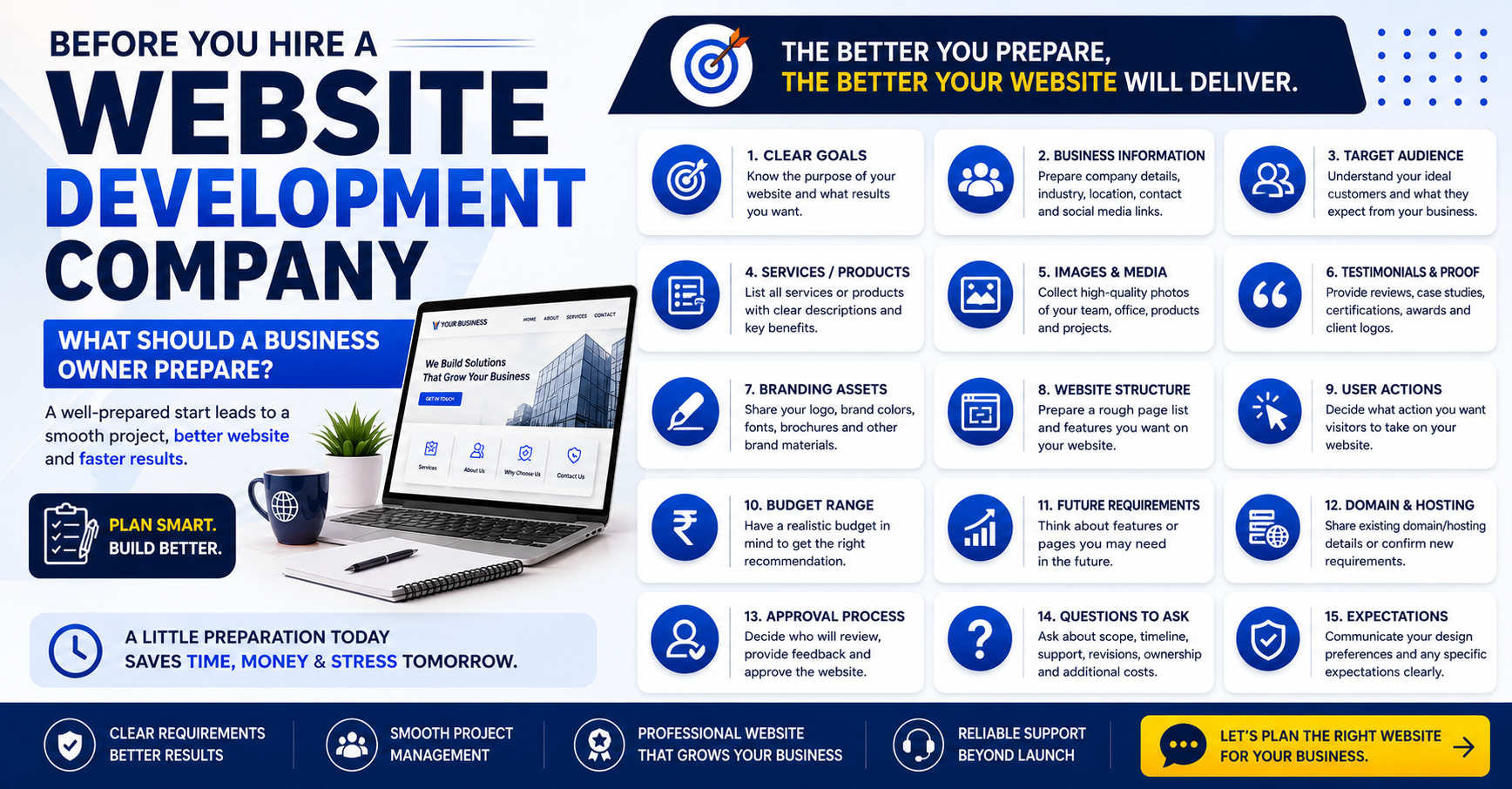
Hiring a website development company is an important decision for any business.
But many website projects don’t become difficult because of the developer.
They become difficult because the project starts without a clear understanding of what the business actually needs.
The result can be:
- Delayed projects
- Repeated revisions
- Missing content
- Confusing requirements
- Unexpected costs
- Poor communication
- A website that doesn’t match the original business objective
The good news is that business owners can avoid many of these problems by preparing a few important things before the first development meeting.
You don’t need to know how to code.
You simply need to know your business well.
1. Be Clear About Why You Need a Website
Before contacting a web development company, ask yourself:
What should this website actually do for my business?
Your goal could be:
- Establish an online presence
- Generate enquiries
- Showcase services
- Display products
- Build brand credibility
- Receive bookings
- Sell products online
- Attract local customers
- Generate B2B leads
- Provide information to existing customers
A website built only because “everyone has one” may not deliver much value.
A website built around a specific business objective has a much clearer direction.
Start with the goal, not the design.
2. Prepare Your Business Information
Your development team needs to understand what your business actually does.
Prepare basic information such as:
- Company name
- Year established
- Business location
- Industry
- Main services/products
- Target customers
- Areas you serve
- Business contact details
- Email address
- WhatsApp number
- Social media profiles
The more clearly you explain your business, the easier it becomes to structure the website correctly.
3. Know Your Target Customer
A website shouldn’t be written for “everyone.”
Think about your ideal customer.
For example:
Who are they?
What problem are they trying to solve?
What information do they need before contacting you?
What makes them choose one company over another?
A website for a manufacturer will communicate differently from a website for a salon, hospital, real estate company or software business.
Your customer should influence your website structure.
4. Make a List of Your Services or Products
Before development starts, prepare your complete service or product list.
For each major service, try to provide:
- Service name
- Short description
- Key benefits
- Who it is for
- Important features
- Relevant images
- Frequently asked questions
- Contact/enquiry requirement
This helps the developer and content team determine how many pages or sections the website actually needs.
It can also prevent the common situation where a business launches a website and later says:
“We forgot to add this service.”
5. Keep Your Branding Materials Ready
If your business already has branding, collect everything in one place.
You may need:
- Logo
- Logo in PNG/SVG format
- Brand colors
- Fonts
- Business card
- Brochure
- Existing advertisements
- Product packaging
- Brand guidelines
If you don’t have a defined brand identity yet, tell the website company.
They can then design the website without having to guess your visual preferences.
6. Collect Good Quality Images
Images can dramatically affect how a website feels.
Prepare relevant photographs such as:
- Office
- Factory
- Team
- Products
- Projects
- Services
- Equipment
- Work environment
- Completed projects
- Company events
Avoid sending dozens of random images without explanation.
Instead, label them properly:
office-front.jpg
team-photo.jpg
product-model-01.jpg
project-noida.jpg
This saves time during development.
7. Collect Testimonials and Business Proof
If customers already trust your business, your website should be able to communicate that.
Prepare:
- Customer testimonials
- Google reviews
- Case studies
- Certifications
- Awards
- Licenses
- Industry memberships
- Client logos, where permitted
- Completed project details
Don’t worry if you don’t have everything.
Even a few genuine proof points can be more valuable than a large amount of generic marketing text.
8. Decide Which Websites You Like
This doesn’t mean copying another company’s website.
Instead, collect 2–5 examples of websites you like.
Then explain what you like about each one.
For example:
“I like the navigation on this website.”
“I like the way their services are presented.”
“I like this color combination.”
“I like their enquiry section.”
This gives your development team useful design direction without turning the project into a copy-paste exercise.
9. Prepare a Rough Page List
You don’t need to create the entire website structure yourself.
But having a rough idea helps.
For example:
Home
About Us
Services
Service Detail Pages
Portfolio
Testimonials
Blog
Contact
Privacy Policy
Depending on your business, additional pages may be required.
The important thing is to discuss the structure before development begins.
10. Decide What Actions You Want Visitors to Take
This is one of the most important things businesses forget.
Ask:
“After visiting my website, what do I want the customer to do?”
For example:
- Call us
- Send a WhatsApp message
- Request a quotation
- Fill out an enquiry form
- Book an appointment
- Buy a product
- Schedule a consultation
- Visit our location
This helps the development team design the website around an actual customer journey.
11. Set a Realistic Budget
You don’t necessarily need to decide an exact figure immediately.
But you should have a realistic budget range in mind.
For example:
Basic business website: ₹X–₹Y
Advanced website: ₹X–₹Y
E-commerce/custom functionality: ₹X–₹Y+
The important thing is to tell the developer about your requirements and budget honestly.
A good development company can then recommend an appropriate solution instead of building unnecessary features.
12. Think About Future Requirements
Don’t only think about what you need today.
Ask:
“What might my business need six months or one year from now?”
You may later want:
- More service pages
- Blog
- Online payments
- Booking system
- Customer portal
- CRM integration
- Lead management
- E-commerce
- Multiple languages
- Landing pages
A website doesn’t need every feature on Day 1.
But it should ideally be planned so that future expansion isn’t unnecessarily difficult.
13. Prepare Your Domain and Hosting Information
If you already own a domain or hosting account, keep the details available.
But don’t casually share passwords over WhatsApp or email.
Instead, use secure access methods or create appropriate user accounts where possible.
Also confirm who will own and control:
- Domain
- Hosting
- Website administrator
- Business email
- Analytics
- Other important digital assets
Your website is a business asset, so ownership should be clear.
14. Decide Who Will Approve the Website
This sounds simple, but it can prevent major delays.
If five different people are giving contradictory instructions, development can become unnecessarily slow.
Decide:
Who is the final decision-maker?
That person can collect internal feedback and provide consolidated approvals.
This makes communication much easier.
15. Prepare Your Questions for the Development Company
Before hiring a company, ask:
What exactly is included in the quotation?
How many pages are included?
Who provides the content?
Who provides the images?
How many revisions are included?
What technology will be used?
Will the website be mobile responsive?
Will I receive admin access?
Who owns the domain and hosting?
What support is available after launch?
What are the additional/recurring costs?
Can the website be expanded later?
Getting clear answers before starting can prevent many misunderstandings later.
A Simple Pre-Website Preparation Checklist
Before your first serious discussion with a website development company, try to have these ready:
- Business name and basic information
- Clear website objective
- Target customer information
- Service/product list
- Logo and brand assets
- Business photographs
- Testimonials/reviews
- Certifications or awards
- Contact information
- Social media links
- Preferred website examples
- Rough page requirements
- Desired customer actions
- Approximate budget
- Future website requirements
- Domain/hosting information, if already available
- List of questions for the development company
You Don’t Need to Know Everything Before Hiring a Developer
This is important.
You don’t need to arrive with:
- A complete sitemap
- Final website copy
- Perfect designs
- Technical specifications
- Coding knowledge
That’s what a professional website development team is there to help with.
Your responsibility is to bring business knowledge.
The development company’s responsibility is to turn that knowledge into an effective digital solution.
The better the information you provide, the better the team can build around your business.
Final Thought
A successful website project starts long before the first line of code is written.
It starts with a conversation about:
Your business.
Your customers.
Your goals.
Your services.
Your brand.
Your future.
When these things are clear, website development becomes much more straightforward.
So before you hire a website development company, don’t worry about learning how websites are coded.
Instead, prepare the information that only you, as the business owner, truly know.
Your developer knows how to build the website.
You know what your business needs the website to achieve.
Together, that’s where a better website begins.
🚀 Planning Your Business Website?
At Kirali Web Services, we help businesses turn their business requirements into professional websites designed around their brand, customers and goals.
If you’re not sure what pages, features or structure your business website needs, you don’t have to figure everything out alone.