
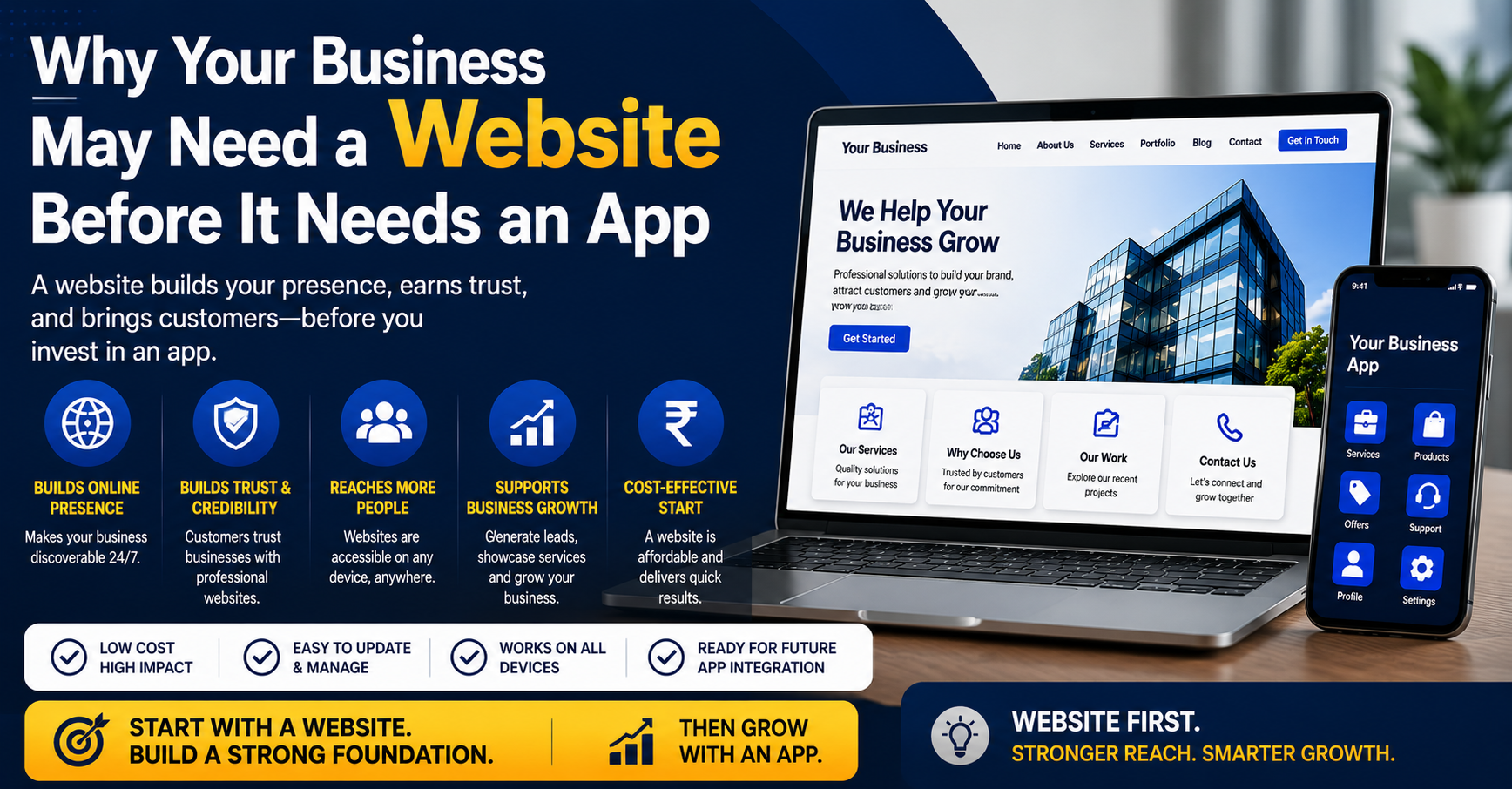
When a business wants to grow digitally, one question often comes up:
“Should we build a website or an app?”
Apps can be powerful. They can improve customer engagement, support loyalty programs, enable bookings, manage orders and provide personalized experiences.
But for many businesses, building an app should not be the first step.
A professional website can often provide a stronger foundation at a lower cost, while helping the business establish its online presence, attract new customers and understand what customers actually need.
The right question isn’t whether websites or apps are better.
The real question is:
What does your business need right now?
1. A Website Reaches Almost Everyone
One of the biggest advantages of a website is accessibility.
Customers don’t need to download anything.
They can simply search for your business and open your website from:
- Social media
- Online advertisements
- Search engines
- Business directories
- Shared links
A website works across smartphones, tablets, laptops and desktops.
An app requires an additional step.
The customer has to find it, download it, install it and sometimes create an account before using it.
For a business trying to reach new customers, those extra steps can create unnecessary friction.
2. Customers Often Search Before They Download
Imagine someone hears about your company for the first time.
What are they likely to do?
They may search:
“ABC Company”
“ABC Company services”
“ABC Company near me”
“ABC Company reviews”
A website can immediately provide the information they need.
An app usually becomes more useful after the customer already knows and wants to engage with your business regularly.
That’s why a website can be particularly valuable during the customer acquisition stage.
3. A Website Can Build Your Brand First
Before asking customers to download an app, you need to give them a reason to trust your business.
Your website can communicate:
- Who you are
- What you offer
- Your experience
- Your services
- Your portfolio
- Customer reviews
- Case studies
- Contact information
- Company location
- Frequently asked questions
It becomes a central place where customers can understand your business.
Once your brand has established trust, an app may become a natural next step.
4. An App Is Not Automatically Better
Having an app doesn’t necessarily make a business look more professional.
An app makes sense when it solves a specific customer problem.
For example, an app can be useful for businesses that need:
- Frequent customer logins
- Online ordering
- Appointment management
- Loyalty programs
- Real-time notifications
- Customer dashboards
- Membership systems
- Delivery tracking
- Personalized experiences
- Regular repeat interactions
If customers only visit your business once or twice a year, asking them to download an app may not provide much value.
5. Websites Are Usually Easier to Discover
A website can be discovered through search engines.
Someone who has never heard of your company can search for a service and potentially discover your business.
An app is different.
People generally need to know your brand or app name before searching for it in an app store.
This makes a website particularly useful for businesses that are focused on attracting new customers.
6. A Website Can Support Your Marketing
Your website can become the destination for your digital marketing campaigns.
For example:
Google Ads → Landing Page → Enquiry
Social Media → Website → Service Information → Contact
Google Search → Website → Service Page → Lead
WhatsApp → Website → Business Information → Enquiry
This makes your website a central part of your marketing ecosystem.
An app can complement this system later, but a website can often provide the foundation first.
7. You Can Validate Your Business Idea Before Building an App
Developing an app can require significant planning, design, development, testing and ongoing maintenance.
Before making that investment, it can be smarter to understand how customers actually interact with your business.
A website can help you learn:
- Which services people view
- Which pages attract visitors
- What customers search for
- Which offers generate enquiries
- Where visitors come from
- Which content gets attention
- What customers ask about
This information can help you decide whether an app is genuinely necessary.
Instead of guessing what customers want, you can use real behaviour to make the decision.
8. A Website Can Be Your Digital Foundation
Think of your digital presence as a structure.
Your website can sit at the center.
Around it, you can connect:
- Google Business Profile
- Social media
- Email marketing
- Online advertising
- CRM
- Analytics
- Lead forms
- Payment systems
An app can then be added when your business has a clear reason for it.
This approach allows your digital ecosystem to grow according to your actual requirements.
9. The Cost Isn’t Just About Development
Many businesses compare the initial development price and stop there.
But an app can also involve:
- UI/UX design
- Android development
- iOS development
- Backend development
- Database management
- Testing
- App store requirements
- Security
- Updates
- Bug fixing
- Ongoing maintenance
If the app doesn’t solve an important customer problem, the investment may not produce the expected value.
A website may provide a more practical starting point for many businesses.
10. When Should You Actually Consider an App?
An app may make sense when your customers interact with your business frequently and need functionality that a website cannot provide conveniently.
Consider an app if you need:
Regular customer engagement
Customers use your service repeatedly.
Personalized accounts
Customers need dashboards, profiles or personalized information.
Push notifications
You need to communicate directly with customers on their devices.
Transactions
Customers regularly place orders, make bookings or manage payments.
Complex workflows
Your business requires functionality beyond a typical website.
Customer convenience
An app significantly improves an existing customer process.
If these requirements don’t apply to your business, a website may still be the better starting point.
Website vs App: What Should You Choose?
| Requirement | Website | App |
|---|---|---|
| Online presence | Excellent | Limited |
| Google search visibility | Excellent | Limited |
| New customer discovery | Excellent | Lower |
| Easy access | Excellent | Requires download |
| Business information | Excellent | Good |
| Regular customer engagement | Good | Excellent |
| Push notifications | Limited | Excellent |
| Customer accounts | Possible | Excellent |
| Complex functionality | Possible | Excellent |
| Development cost | Usually lower | Usually higher |
| Best for first digital presence | Often yes | Not always |
The decision should depend on your business model rather than following a trend.
A Simple Rule for Business Owners
Ask yourself these three questions:
1. Do customers need to discover my business online?
If yes, a website is highly valuable.
2. Do customers need to interact with my business frequently?
If yes, an app may eventually become useful.
3. Does an app solve a problem that a website cannot solve efficiently?
If yes, consider developing an app.
If the answer to the third question is no, you may not need an app yet.
Don’t Build an App Just Because Your Competitors Have One
Technology should solve a business problem.
It shouldn’t simply follow a trend.
Your competitor may have an app because their customers order frequently.
Another company may need an app because they operate a membership platform.
Another business may not need one at all.
Your digital strategy should be based on your own customers, processes and goals.
Start With the Foundation
For many businesses, the smarter digital journey can look like this:
Business Website → Online Visibility → Customer Enquiries → Data & Insights → Process Improvement → App When Needed
This approach allows the business to grow its digital presence step by step.
You don’t have to build everything at once.
Build what your customers need today and create a foundation that can support what your business may need tomorrow.
Final Thought
An app can be an excellent investment for the right business.
But having an app doesn’t automatically make a business more successful.
For many businesses, the first priority should be creating a professional website that clearly communicates the brand, attracts potential customers and provides an easy path to enquiry or purchase.
Once your business understands its customers and has a strong digital foundation, you can decide whether an app is the right next step.
Don’t build technology because everyone else is building it.
Build technology because it solves a real business problem.
Planning Your Business Website?
At Kirali Web Services, we help businesses plan and develop professional websites around their services, customers and business objectives.
If you’re unsure whether your business needs a website, an app or both, start by understanding what your customers actually need.
Build the right digital solution for your business—not simply the newest one.
CTA: Discuss Your Website Requirements →